Government : Apply now for admission to tertiary institutions

higher-education

Higher Education and Training Deputy Minister, Mduduzi Manana, has encouraged learners to apply at institutions of higher learning for the 2016 academic year now.

September is the cut-off deadline for many institutions of higher learning.

The Deputy Minister said this on Tuesday as he rolled out the 2015 Apply Now/Khetha Career Guidance Campaign at three schools in Bergville, in KwaZulu-Natal.

The campaign is aimed at encouraging learners to apply on time for admission to post-school institutions to avoid the last minute rush at the beginning of each academic year. The campaign runs from March to September each year.

“The campaign was initiated by the department, following the unfortunate incident that happened at the University of Johannesburg in 2012, where a mother died in a stampede whilst accompanying her child to submit a late application.

“The career guidance component of the campaign seeks to inform learners about career choices available within the post-school education and training (PSET) sector,” the Ministry said.

Among the learners who attended the event was Silindile Kubheka. The 18-year-old is President of the Learner Representative Council at Mhlawazini High School.

She encouraged learners to heed the call and apply on time. “We promise to obtain above 80% pass for matric so we can benefit fully on the opportunities shared by the Honourable Deputy Minister,” said Kubheka.

The Deputy Minister encouraged learners to consider Technical Vocational Education and Training (TVET) colleges as an alternative to university education because the skills needs of the country necessitate a massive production of artisans from TVET colleges.

He also promoted the 100 occupations in high demand list that was released by the Minister of Higher Education and Training Blade Nzimande in 2014.

This will assist learners to make informed career choices to avoid a situation where they too join a cohort of unemployed and unemployable graduates, said the Ministry.

The department is currently running a career development services centre to assist learners with career advice.

Deputy Minister Manana encouraged learners to use their cell phones to reach the centre by sending an SMS or a “Please Call Me” to 072 204 5056. – SAnews.gov.za

Newcastle Municipality Celebrates Women’s Month

womens-month-banner

Newcastle Municipality salutes the courage of women such as Charlotte Maxeke, Lillian Ngoyi, Hellen Joseph, Rahima Moosa and many others who fought tirelessly against the brutality of the apartheid government, when they marched to the Union Buildings on 9 August 1956 in protest against the extension of Pass Laws to women.

In line with national government, Newcastle Municipality has made great strides in the advancement of women since the first democratic elections, to ensure that women enjoy the same rights as their male counterparts in relation to education, employment, property, inheritance and justice. Women such as Dorothy Nyembe who hails from our neighbouring town Dundee, paved the way for young girls and women to shape their futures and not be discriminated based on their gender. Our very own Newcastle Municipality, Deputy Mayor, Cllr Racheal Mdluli is an example that young girls can succeed in every career they choose to embark on. Our democracy was built on the actions of the women of
the liberation movement and our Municipality acknowledges that more still needs to be done, to cast off the chains that still hinder the progress of some women. During the month of August, the Newcastle Municipality has planned a variety of programmes to uplift women in business, education and safety.

Women are the guardians of our nation and Newcastle Municipality celebrates women in August and every other month of the year. The Newcastle Municipality will continue uplifting and championing the rights of women because our nation can only become a true success when our women are treated equally and are also successful. Let us unite to move women empowerment forward to combat poverty and encourage sustainable development. Newcastle Municipality salutes all women in our Municipal office and every corner of our communities.

Malibongwe igama lamakhosikazi
Let the name of women be praised.

MEDIA STATEMENT : Government values the swift process by the National Energy Regulator

Government values the swift process by the National Energy Regulator of South Africa (NERSA) in reviewing the selective reopener for the third multi-year price determination for the period 1 July 2015 to 31 March 2016 that was submitted by Eskom.

As a selective reopener application, it was specifically to fund only the higher usages of the Open Cycle Gas Turbines and cover the cost of buying capacity from the short-term power purchase programme. Eskom is in the process of preparing for its full application to Nersa with regard to the Third Multi-Year Electricity Price Determination which will be submitted before the end of July 2015.

By ensuring that the requirements which are needed for our energy sector are promptly addressed it allows us to stabilise our electricity network and move South Africa forward.

Government appreciates the work of NERSA which is a product of our democratic dispensation. It ensures that there are checks and balances within the country’s energy sector.

It is mandated as the country’s independent single regulator and created under National Energy Regulator Act to protect the both interest of energy producers and consumers.

This is part of our commitment as an open, transparent and democratic society that we had envisioned at the start of democracy. It keeps South Africans informed and allows them to play an active role in the direction of the country.

Regulators and governance institutions established since 1994 ensure management of key sectors to meet the country’s needs and citizens have a say on matters that affect them.

In May 2015 NERSA had begun to process the Eskom application. This included a period of written comments from stakeholders which ended on 15 June 2015 and public hearings that were held on 23 and 24 June 2015.

NERSA afforded everyone, stakeholders and members of the public alike with an opportunity to participate in the public hearings. These were open meetings between officials and citizens, during which citizens offered their comments and views on application.

These interactions reflects the power of our democracy at work as more than 250 submissions had been made by members of the public and civil society organisations.

In keeping with our democratic principles, the views and interests of all stakeholders are incorporated into NERSA’s decisions. In assessing the Eskom application, NERSA would also consider all other possible funding options such as raising additional debt.

The Eskom application has been extensively discussed by the War-room on Energy and is one of a number of options that are being considered to ensure the continued supply of electricity and address Eskom’s financial stability.

Government appreciates the speedy conclusion of the process and thanks all South Africans for their input. As a people-led Government, we care about what citizens think and feel about the policies and programmes that we have put in place to address priorities as mandated by South Africans. We need to work together to move South Africa forward.

Effects of prevailing drought conditions in the region

water-shortage-kzn-dams-006

INTRODUCTION
Following a statement released by the MEC for Dept. of Co-operative Governance and Traditional Affairs, the Honourable Nomusa Dube-Ncube concerning the latest drought situation in the province, the Newcastle Municipality – aspires to update and notify the public concerning the current raw water resource situation within our district.

PURPOSE
The purpose of this press release is to ensure that the public is fully aware of the extent and gravity of the current prevailing drought conditions, and the possible ramifications for the region as a whole, should these drought conditions persist indefinitely and beyond the next ensuing rainy season. All sectors of the community should start conserving this scarce resource now, rather than later, and by doing so ensure that we are not as badly affected as other areas of the province, where severe austerity measures have already been implemented.

ESTABLISHED RAW WATER RESOURCES AND SUPPLIES
Under normal circumstances, the Water Service Areas are supplied with purified bulk water from the following water plants and raw water resources:
The Newcastle municipal areas, including Madadeni, Osizweni, Kilbarchan and the Eskom village, are supplied with purified bulk water via the Ngagane Water Purification Plant, which obtains its raw water extraction mainly from the Ntshingwayo Dam (70 mega-litres per day); its tributary the Ngagane River (30 Mega-litres per day); and the Buffalo River (28 Mega-litres per day).

The Amajuba District municipal areas of Dannhauser and Durnacol are supplied with raw water from the Ntshingwayo Dam; and the rural areas of Steildrift, Waterval, and Alcockspruit are supplied with purified water from the Ngagane Water Purification Plant, sourced from the Ntshingwayo Dam. The Emadlangeni (Utrecht) area is supplied with purified water locally obtained from the perennial Dorpspruit River and its storage dam. The capability exists that this supply can be augmented via the Emadlangeni bulk water supply line that feeds off the Ngagane Water Purification Plant via the Ntshingwayo Dam. The Hattingspruit community area is supplied with bulk purified water from the Biggarsberg Water Purification Plant.

HOW THE CURRENT DROUGHT HAS AFFECTED THE RAW WATER RESOURCES
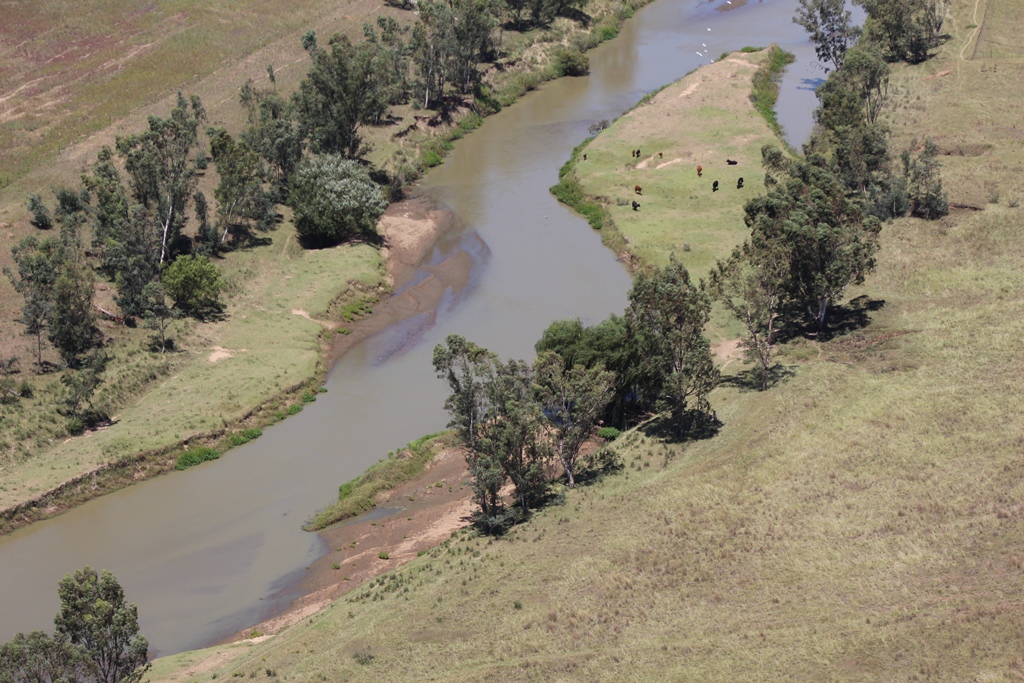
Firstly, the Buffalo and Ngagane Rivers are historically very dependent on good and sustained rainfalls in the summer months to maintain good flows and to fill the main dam supplies higher up in the catchment areas. The smaller subsidiary dams likewise depend on good rainfalls in their catchment areas to reach good and sufficient water levels. As a direct consequence of poor rainfalls during the past rainy season, the water levels in the Buffalo and Ngagane Rivers has, since early December 2014, dropped considerably, and these Rivers are currently being supplied and maintained by an additional extra-ordinary water release from both of the Ntshingwayo and Zaaihoek Dams.

Without this additional water supply, there would be zero flow in these rivers – without these vital river resources, the Newcastle area would suffer a 44% reduction in raw water supply – 24% from the Buffalo River and 20% from the Ngagane River – and the effect on the Umzinyathi area would be devastating, reducing their raw water supply by about 95%.

POSSIBILITY Of WATER TRANSFERS
The level of the Ntshingwayo Dam currently stands at 73%, and the Zaaihoek dam at 82%. It should be noted that the Zaaihoek dam is not a licensed raw water supply extraction point, and that the emergency water supply currently being released from this dam to assist with the drought situation, is at the discretion of the Department of Water Affairs, who has other contractual obligations concerning this water resource.

The area of Hattingspruit is consequently now being almost exclusively supplied from the Buffalo River, via the releases of additional water flows from the Ntshingwayo Dam. The Emadlangeni (Utrecht) local town perennial Dorpspruit River and dam level is currently perilously low at 24%, and this town could soon be fully dependant on a supply from the Ngagane Water Purification Plant via the Ntshingwayo Dam.
It is also significant to note that the Buffalo and Ngagane raw water resources are also shared by other vital economic sectors of the region i.e., agriculture, mining, and industry; and that these sectors have already been adversely affected by the low river levels in terms of production output.

APPEAL
It is therefore a humbly appeal and a warning to the consumers that if the situation persist as per prediction, water cut backs will be unavoidable in both Newcastle West and East. Water restrictions and other measures shall be implemented in line with the council by laws. Excessive use of water and irresponsible car washing business is condemned in strongest possible terms and discouraged.

RECOMMENDED WATER SAVING MEASURES
1. All sectors should reduce water consumptions in a controlled and responsible manner, limiting use to the absolutely essential in order to reduce excessive and unnecessary demands on a diminishing and scarce resource.
2. Water losses should be reduced by fixing leaking taps and pipes, or reporting them to 0860 144 144.
3. The implementation of controlled water conservation and demand management measures by the authorities (already in place).
4. Regional water planning and monitoring of drought conditions, and the planning of possible austerity measures to properly manage the situation (already in place).

Newcastle Saving Water for The Benefit of KZN

Newcastle Municipality saving water for the benefit of KZN
The worst drought since 1991 has tightened its grip on the province as households and businesses across various municipalities in KwaZulu-Natal will implement new water restrictions, warned MEC for Co-operative Governance and Traditional Affairs Nomusa Dube-Ncube.

MEC Dube-Ncube said two months is how long some residents in our province have before their taps run dry. “We need to start preparing ourselves for the worst, it’s time for everyone to acknowledge that there isn’t an endless water supply,” said the MEC.

The Cogta Department also revealed that the amount of water available has now dropped below 30 % and warned that the numbers could fall lower. Dam water levels started to decline in October 2013 when the province received minimal rainfall for two seasons. Although Newcastle Municipality is not yet directly affected by the drought like the rest of the province, as the community of Newcastle we must not turn our backs on our neighbours, we must fully participate in conserving water for the benefit of all who reside in KZN.

Honourable Mayor Cllr Afzul Rehman is encouraging every citizen of Newcastle to remember that water is a precious source and therefore should be used with care. Mayor Rehman mentioned that while the Municipality is not currently under immediate threat, the low rainfalls across the province also put Newcastle in danger of water shortages within the next few months. “Our wish to Newcastle water customers is that they will use water sparingly, make sure leaks are reported and fixed by the Municipality and consciously save water,” said the Mayor.

Mayor Rehman has urged Newcastle residents to make water conservation part of their everyday lives and follow water saving tips provided by the Municipality.

• Turn off the water while you brush your teeth and shave.
• Make sure that the tap is closed after you have finished using it.
• Take a shower instead of a bathtub.
• When taking a bathtub do not fill up the water to the top of the tub.
• When cooking do not fill up the pot with water.
• Ensure that toilet and pipe leaks anywhere in the house are fixed
• Only flush the toilet when it is necessary.
• When washing your motor vehicle, use a bucket instead of a hose pipe.

Save Water Tips

“Saving water is not an event, but a lifestyle”

• Close the tap when shaving or brushing your teeth.
• Make sure that the tap is closed after you have finished using it.
• Do not feel up the bathtub to the top when taking a bath.
• When you use a bathtub for bathing, it takes from 80 to 180 litres of water to fill. Use a shower so that water will not be wasted.
• When cooking do not fill the pot with water as this wastes water.
• Ensure that leaking toilet cisterns and pipes anywhere in the house are fixed, this can curb the loss of 100 000 litres of water.
• Only flush the toilet when it is necessary.
• When washing your motor vehicle, use a bucket instead of a hose pipe.

The community is encouraged to report water and sanitation related queries/problems, by call our 24 hour call centre – on 0860 144 144, in order to get help.

Winter Fire Safety Precautions

The rising number of households and agricultural land ravaged by fires every winter concerns the Newcastle Fire Service. It is a known fact that fires can never be prevented, since it`s crucial element in preserving nature. However, we can prevent fires from damaging items and areas of value.
It is therefore the role of each one of us to join efforts in the fight against unwanted fires.
The fire department has the following Fire Safety tips for the residents.
• Always remember all fires start small.
• Fires need oxygen, something to light it and something that can burn.
• Removing any of the three elements stops the fire.
• Avoid unnecessary open flames.
• Keep your property free of grown and dry vegetation.
• Make firebreaks around your property (farm).
• Check Fire Danger Index (FDI) with the Fire Protection Association (FPA) office and /or fire department before making a firebreak.
• Avoid accumulation of combustibles in an unprotected area.
• Do not take a chance with open fires on a windy day.
• Keep matches away from children
• Keep fuel can away from children
• Make sure you extinguish the fire after a braai.
• Report ALL FIRES you can see regardless of size.
• Switch off the heater and stoves when you go to bed or when leaving the house.
• Do not place heaters to close to bed linen or curtains or any combustible material.
• Do not overload electrical plug sockets.
• Do not leave children alone in the house with heater/stove on.
• Stay away from bad habits that can cause harm to life, property and environment.
• Report ALL FIRES on 034 312 1222

Izigwemamlilo nokuvikeleka kobusika
Ukukhula kwezindlu nobukhona kwamasimu kwenza imililo eminingi ngezikhathi zobusika, kuyazeka ukuthi imililo ayigwemeki kalula ngenxa yemvelo.

Ngezinye izindlela singavikela imililo ekuthen ingalimazi imfuyo nezindawo ezibalulekile. Kuwumsebenzi wethu ukuba sihlangane sibe yimbumba ekutheni silwe nemililo engenasidingo
Thina njengomnyango wezicishamlilo kanye nokuhlenga sinalezi ziqwashiso emphakathini.
• Khumbula yonke imililo iqala imincane.
• Umlilo udinga umoya (oxygen), udinga into ewumlilo njengomentshisi (heat) nento ezovutha (blanket).
• Uma ususa okukodwa kulokhu kokuthathu okuyizimbangela zomlilo kuyawumisa umlilo.
• Gwema imililo engenasidingo ezindaweni ezivulekile.
• Vikela isakhiwo singabi nesikhotha nezitshalo ezivulekile.
• Khanda ibhande (firebreak) uvikele isakhiwo.
• Landela imigomo ngokuthinta izicimamlilo uma ufuna ukwenza ibhande noma ukuvikela isakhiwo.
• Gwemani ukubeka inkunkuma endaweni engavikelekanga ngoba kungadala umlilo.
• Ungawubasi umlilo uma kunomoya.
• Ungabeki umentshisi lapho kufinyelela khona izingane.
• Ungabeki izigubhu eziphatha izinto eziwubulwangulwangu
• Cima umlilo uma benikade ninezoso.
• Bika ezicimamlilweni umlilo eniwubonayo ningabheki ubungako bawo.
• Cima izifudumezi (heater) kanye nezitofu ngaphambi kokuyolala noma uhamba endlini.
• Ungasondezi izifudumezi eduzane kwamakhethenisi, imibhede kanye nezimpahla ezisheshe zibambe umlilo.
• Ungatakelanisi izintambo zikagesi
• Ungashiyi izingane zodwa endlini nesitofu noma isifudumezi singacishiwe.
• Ungalahli isitompi sikagwayi etshanini obomile ngoba loko kungalimaza izimpilo, imfuyo kanye nemvelo.
• Bika yonke imililo kulenamba yosizo oluphuthumayo kulenombolo ethi 034 312 1222

Dam levels of pumped storage power stations

Eskom has often told the public that one of the reasons for load shedding over weekends is to fill up the dams at our pumped-storage stations.

Background
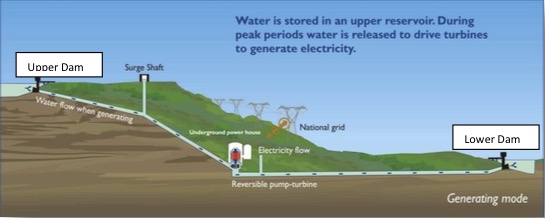
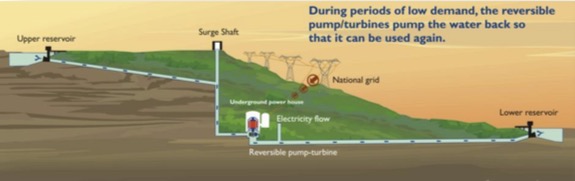
A pumped storage scheme consists of lower and upper reservoirs with a power station/pumping plant between the two. Eskom has two such stations – Palmiet near Grabouw in the Western Cape and Drakensberg near Bergville in KwaZulu-Natal. During off-peak periods, when customer demand for electricity has decreased, the reversible pump/turbines use electricity from the national grid to pump water from the lower to the upper reservoir. During periods of emergency or peak demand, this water is allowed to run back into the lower reservoir through the turbines to generate electricity. In this way, the potential energy of water stored in the upper reservoir is released and converted into electricity when needed. Because it is necessary to pump the water back after use, pumped-storage power stations can only provide energy for limited periods of time.

dam1

dam2

Pumped-storage schemes (and hydro-electrical stations) respond very quickly to changes in the demand for electricity. They can be brought on-stream within three minutes and play a major role in maintaining the stability of Eskom’s national network. They are, however, more expensive to operate than conventional hydro-electric power stations because of the pumping costs.
Why the need to fill the dams over weekends?

When generation capacity is needed, water flows down the system from the top dam, through the generators to the bottom dam. When Eskom no longer needs power from the pumped-storage stations, and there is enough power to transfer the water back, this water is pumped up to the top dam ready to generate again when needed (this pumping actually uses electricity from the grid). For every 4 hours pumped back only about 2.6 -3 generating hours are obtained.

In summer Eskom needs to use these stations for more hours per day (up to 16 hours) compared to the opportunity to pump the water back (7 – 8 hours). Hence significant pumping is required to be done over weekends as the dams cannot be completely filled during the week. This is not really an issue in winter as the peak demand is higher but for shorter periods of the day, which means that the pumped-storage stations need to generate power for fewer hours per day.

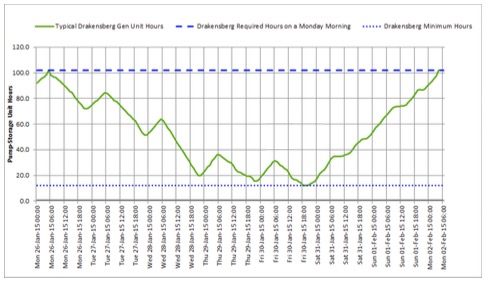
The graph below shows an example of a typical summer week usage of Eskom’s Drakensberg pumped storage station.

graph

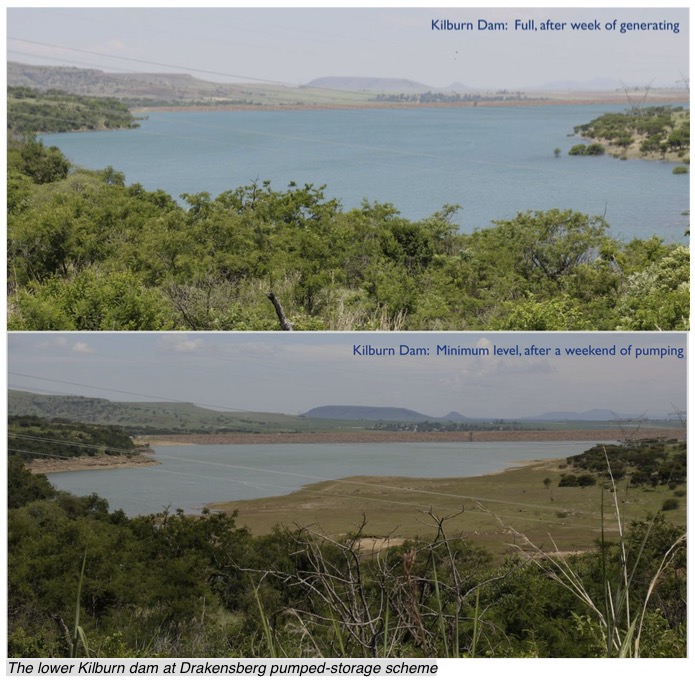
On a Monday morning the dam is full. This implies maximum generating capacity for the week. The available capacity of the dam is equivalent to one unit (250 MW) generating for 102 hours or all 4 units (1000 MW) generating for 25.5 hours. The graph shows the dam levels reducing during the day, a slight increase at night when it is possible to pump, and then decreasing the next day. Over the weekend, it is necessary to pump for many hours (with little use of it for generation) to ensure a full dam by Monday morning. For instance, at the Palmiet station over weekends, when system demand is low, water is pumped back from the lower Kogelberg into the upper Rockview reservoir over a period of about 37 hours to restore the reservoir to full capacity.
This is sometimes the reason behind load shedding over weekends – to ensure full capacity at these stations by Monday morning so that these stations can generate power when needed during the week when electricity demand is higher.

The lower Kilburn dam at Drakensberg pumped-storage scheme

The right generator for load shedding

[wpdm_file id=546]

Selecting the right type of generator
Eskom has received many requests for information on the buying of generators and how to connect their generators at their homes. Generators are now available in a wide range of sizes. Generators with power supply capacities of 5kW to 50kW are readily available in the personal and home use markets, while industrial generators are anywhere from 50kW to over 3 Megawatts. A genset is either petrol or diesel driven, and is mechanically connected to an electrical generator. The engines need to be started either using a rope attached to the engine similar to that of a lawnmower or with a starter motor and a switch.

The generator part of the genset will start generating power once the engine starts and will stabilise at around 220 volts until a load or wattage is connected. This is where it is vitally important to decide what load is to be connected to the genset. Unfortunately, generator under sizing is one of the most common mistakes committed by buyers. Not only could it damage your generator, but it can also damage other assets connected to it, create hazardous situations, and even limit overall productivity of the unit and/or the business relying on it. If nothing else, the key thing to remember here is that more is always better than less.

Things to consider when buying a generator:
• Safety: Generators need to be correctly installed and/or connected to the building via a suitable and approved change-over switch including installation of an over current protection circuit breaker in the main distribution board by a certified electrician in terms of certificate of compliance SABS 1- 0142
• Total electrical load to be connected
• Voltage, frequency and phase
• Does the generator need to start automatically? If so, then an automatic mains failure (AMF) mechanism needs to be installed. If not, a procedure needs to be put in place for manual start and switch over.
• Suitable location for the generator – outside or in vented area (not to be installed in an enclosed area or indoors)
• Acceptable noise levels
• Altitude and running time

How big a generator should you get?
This capacity depends on the sum (maximum total load expected at any given time) of the electrical loads you want to power simultaneously, measured in watts. First, add up all the loads you know you want to be able to run simultaneously. Then, as a precaution, figure out which electrical item in your house requires the most electricity to start its motor and add that to your total, bearing in mind that the startup current of a pool pump motor, for example, is about 1.4 times the running load and large items like air conditioners and some refrigerators can be two or three times what they use while running. Make sure your generator can accommodate that extra electricity needed so that larger items won’t overload the system if they start up.
Every generator has two wattage ratings: running wattage and surge wattage. Generators are rated for surge wattage because they should have some excess capacity in case the load you need is temporarily larger than what you’ve calculated. When you buy a generator, choose the size based on the running wattage and its surge wattage should automatically fall into line with what you need. If you’re worried about needing more surge wattage, buy a larger generator.

What loads should you consider powering with the generator?
• Kitchen, bathroom and sitting room lights
• One plug in kitchen for kettle or cellphone charger
• Refrigerator/freezer
• Television and decoder
• Garage door opener
• Microwave/oven
• Computer
• Security – alarm systems/electric fencing/lighting

How do you calculate all this?
All heating appliances such as stoves, heaters, dishwashers, geysers, kettles, tumble dryers, toasters and hairdryers draw the most power. Controlling the number of lights switched on during generated power is advisable. PCs and electronic equipment don’t use much power but are voltage sensitive. If the generator does not deliver a constant voltage and there are dips and spikes in the system, equipment is likely to suffer damage. During generator use it is best to switch off some appliances when using others.

In this example you need a generator with the following capabilities:
Recommended wattage: 3 692 (Appliance with the highest starting wattage + total running wattage for all other appliances = total wattage needed)
Maximum wattage: 4700 Voltage: 220-240V

Do you need to hire an electrician to set up a generator safely?
A licensed electrician, who must carry out the installation, must understand and must have experience in wiring the switches, since incorrect wiring of all the live, neutral and earth wires could be life threatening.

The local supply authority should be contacted to determine their particular requirements when a genset is installed.

You can check whether the electrician is registered by contacting the local offices of the Electrical Contracting Board of South Africa. In addition always make sure that he gives you a valid electrical certificate of compliance. NEVER attempt this work yourself and never plug a supply from a genset into a socket of your house. If you do not want to install a changeover switch, a temporary extension lead from the genset can be used to plug in the equipment that you require. The lead size is important to ensure that it can carry the required load.

The transfer or change-over switch is likely to be a manual device which has three switching positions – most have a central off position and a position to the left and right of the off position. One is for the main supply and the other for the generator supply.

This will mean that when the main supply fails, the switch will have to be manually turned from mains to the generator supply. The whole process will have to be repeated once the main supply returns.

This “switching” procedure is a vital part of the process as a “back feed” is both potentially dangerous and can also damage the generator and electronic devices such as computers, TV and hi-fi. The main supply and the generator supply must never run in parallel. These transfer switches can also be automatically controlled, but this is far more complicated and costs a great deal more.

Can’t I just plug my generator into a wall outlet?
No. This is known as backfeeding, and it’s very dangerous for a variety of reasons. For instance, if someone forgets to throw the main circuit breaker to electrically isolate the house from the grid, then the generator could send electrical power beyond the house and out onto the grid. Also should the earth leakage or main switch be left on, when grid power resumes it will destroy your generator and could even cause electrical or other fires and many other hazards. In addition, if you choose to switch off the earth leakage main switch to avoid this issue, you need to remember that your family is at high risk of electrocution as when back-feeding power to your house, since the electrical system will not have earth leakage protection.

What’s the difference between a standby generator and a backup generator?
A standby generator is permanently installed apparatus, much like a compressor for a central air-conditioning system. Its engine runs on natural gas or propane. A backup generator is a small, petrol-engine generator that you wheel into position outside the house and then plug into the transfer switch. Or it can be connected to electrical loads via heavy-duty extension cords.

If it’s raining outside, can you put the generator in the garage and run it there, as long as the door stays open?
No. Never run a generator inside a house, inside a garage, under a carport, on a porch, inside a screened porch or near an open window. Even with the garage door open, the carbon monoxide (CO) in the generator’s exhaust can sicken somebody inside the house or, in the worst case, even kill someone.

What other safety tips should you keep in mind?
Have working smoke and CO detectors in the house when using a generator.
Keep the generator at least 5 metres from the house to minimize risks from CO and also the risk of the generator’s hot muffler melting vinyl siding.
Never fuel a generator while it is operating (running) or when it’s hot as it is a huge
fire/explosion hazard. Remember: “Let it cool before you fuel.”

Generators are loud. What can be done about that?
Unfortunately, not much. More mechanically advanced generators do a better job than older ones at adjusting engine rpm to their electrical output. This reduces their running speed, which is quieter and conserves fuel. The simplest way to reduce generator noise is to reduce the electrical load you’re imposing on it.

Does the generator need to be grounded?
Follow the instructions in the owner’s manual. If the manual calls for grounding the generator, that’s relatively easy to do. One simple way is to run a 12-gauge ground wire from the grounding terminal on the generator to a copper ground rod you’ve driven into the soil next to the generator. (The generator will have a grounding terminal symbol to help you identify the terminal’s location.)

As an alternative, the manual may ask you to run a ground wire from the generator’s grounding terminal to the ground bus inside the house’s service panel. As long as you follow the instructions provided in the manual, the generator will be safely grounded.

Compiled by Eskom Corporate Affairs February 2015

16 Load Shedding Tips and Checklist

A load shedding checklist has been compiled by Eskom. Prepare yourself by doing the following:

[wpdm_file id=545]

Load Shedding Checklist
1. Keep your cell phone fully charged when the power is on. If your cellphone battery is low, remember that you can use your car charger in your car.
2. Invest in a small LP gas lamp for good quality lighting over a large area.
3. Prepare meals beforehand in case of a power outage.
4. Install solar powered security and garden lights.
5. Load shedding may result in alarm systems not operating properly therefore check with your insurer if you are covered should you have a break in while the alarm is not powered.
6. Remember to switch off your oven if it was on when the power outage started.
7. Keep boiled water in thermos flasks for hot drinks during a power outage.
8. Invest in a small LP gas heating ring for essential cooking and to boil water for hot drinks – make sure you have an extra bottle of gas.
9. Make use of surge protection: Electric surges are one of the biggest causes of damage to equipment during a power outage. Installing a surge protection device can help minimise damage. Have a surge protection device fitted to your electrical distribution board.
10. Keep frozen bottled water in your freezer to help keep food cold during a power outage.
11. Keep a battery- powered torch or candles in a place where it will be easy to find in the dark – make sure you have an extra set of fresh batteries.
12. Keep a small torch on your bedside table at all times – make sure you have an extra set of fresh batteries.
13. Keep refrigerator and freezer doors closed at all times – a power outage of four hours should not cause food spoilage and a freezer should keep food frozen and safe for at least a day.
14. Access, security and safety always remain a top priority – Know where the manual release lever of your electric garage door opener is located and how to operate it. Also keep a key to your house with you if you regularly use the garage as the primary means of entering your home, in case the garage door will not open.
15. Most medication that needs refrigeration can be kept in a closed fridge for several hours without spoiling – it is essential that you check with your doctor or pharmacist to be sure about your type of medication.
16. Back up your data: Make it a priority to save your data offsite, in case of a hard drive crash or unforeseen electrical fault. Online “cloud-based” backups are very convenient and are mostly automated, which means that you have one less thing to worry about.